
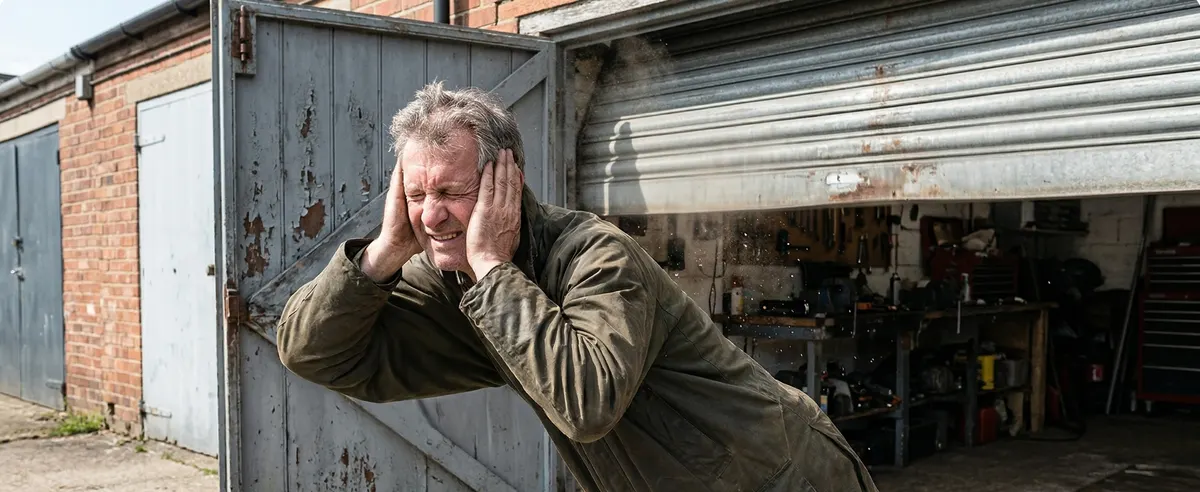
That Noise Is Trying to Tell You Something
A noisy garage door is one of those things people learn to live with until they can't anymore. Maybe you've been tuning it out for months, or maybe the neighbor just mentioned how loud your garage door is at 6 AM. Either way, garage door noise isn't just annoying, it's almost always a symptom of something wearing out, coming loose, or needing maintenance.
The good news: most noisy garage door problems are fixable, and several of them you can handle yourself in under 30 minutes.
Cause #1: Worn Rollers
This is the most common source of garage door noise, and it's the fix that makes the biggest difference. Your garage door rides on rollers, small wheels that travel up and down the tracks every time the door opens and closes. Most garage doors have 10 to 12 rollers.
Steel Rollers vs Nylon Rollers
If your door has standard steel rollers (bare metal wheels with exposed bearings), they're loud by nature. Metal rolling on metal makes noise. As steel rollers wear out, they get even louder, grinding, squeaking, and rattling.
Nylon rollers are a different story. They're made of a hard nylon material with sealed bearings, and they're dramatically quieter. Swapping steel rollers for nylon rollers is the single best thing you can do to reduce garage door noise. The difference is startling, people often think we replaced the whole door when we just changed the rollers.
A set of 10 nylon rollers costs about $60 to $100 for the parts. If you have a technician do it, expect $120 to $175 total. Most of the rollers are straightforward to replace, you tilt the hinge, pop the old roller out, and slide the new one in. The bottom bracket rollers are under spring tension, so leave those for a pro.
Cause #2: Loose Hardware
Your garage door operates under vibration every single cycle. Over months and years, that vibration loosens nuts, bolts, and brackets throughout the system. Loose hardware rattles, and rattling is loud.
Grab a socket wrench and go around every bolt you can reach: hinge bolts, track brackets, roller brackets, the opener mounting hardware. Snug them up, don't overtighten, just make sure nothing is loose. This 10-minute job often cuts noise by 30% to 40%.
Pay special attention to the track brackets where the vertical tracks mount to the wall. If these are loose, the entire track vibrates like a tuning fork every time a roller passes through.
Cause #3: Lack of Lubrication
Dry metal parts grind, screech, and squeal. If you've never lubricated your garage door, or haven't in over six months, this could be your entire problem.
Get a can of garage door lubricant (white lithium or silicone-based, not WD-40) and spray:
- Springs: Coat the full length of every coil. This is the biggest noise reducer after rollers.
- Hinges: Spray where the hinge pivots, where the metal bends.
- Roller bearings: A quick spray on the center of each roller where it spins.
- The opener rail: Light coat along the top where the trolley slides.
Do NOT spray the tracks. Greasy tracks cause rollers to slide instead of roll, which makes things worse and creates a buildup of grime. Wipe the tracks clean with a dry rag instead.
Cause #4: Unbalanced Door
An unbalanced garage door, where the springs aren't providing the right amount of counterbalance, makes the opener work harder than it should. The motor strains, the chain or belt vibrates more, and the whole system gets louder.
To test balance: disconnect the opener by pulling the emergency release cord. Lift the door manually to waist height and let go. A balanced door stays put. If it drops or flies up, the springs need adjustment. Spring adjustment is a job for a technician, don't try to adjust torsion springs yourself.
Cause #5: Chain Drive Vibration
If you have a chain drive opener, some noise is just the nature of the beast. Metal chain on metal rail creates vibration and sound. But if the noise has gotten worse over time, the chain may need tension adjustment or the motor mount may be loosening.
Check if the chain has visible slack when the door is closed. There should be about half an inch of play above the rail. Too much slack means the chain slaps during operation, creating extra noise. Your opener manual explains how to adjust chain tension, it's usually a bolt on the trolley assembly.
If vibration from the opener transfers into the ceiling and walls, an anti-vibration mounting kit ($15 to $30) can help isolate the motor from the structure.
Cause #6: Worn Torsion Spring Coils
As torsion springs age, the coils rub against each other and create a grinding or groaning sound, especially noticeable during the first open of the morning when the metal is cool. If the noise is clearly coming from the springs above the door, they may be nearing the end of their life.
Lubrication helps temporarily, but if the springs are 8+ years old and making noise despite fresh lube, start budgeting for replacement. In Tampa, spring replacement runs $200 to $350 for a pair.
The Quick Quieting Checklist
Here's the order to tackle garage door noise for maximum results:
- Lubricate everything, springs, hinges, roller bearings, opener rail. Takes 10 minutes. Free if you have a can of lubricant.
- Tighten all hardware, every bolt, bracket, and nut you can reach. Takes 10 minutes.
- Replace steel rollers with nylon, biggest noise improvement for the money. $120 to $175 with installation.
- Check chain tension (chain drive openers only), adjust per your opener manual.
- Test door balance, if it's off, call for spring adjustment.
Steps 1 and 2 alone fix the noise problem for about a third of the calls we get. Add step 3 and you've handled 80% of noisy door complaints.
If you've tried everything and the door is still loud, it might be a structural issue, bent tracks, a warped panel, or worn-out springs that need professional diagnosis. Call Champions Garage Door Service at (813) 999-5749 and we'll figure out where the noise is coming from.