
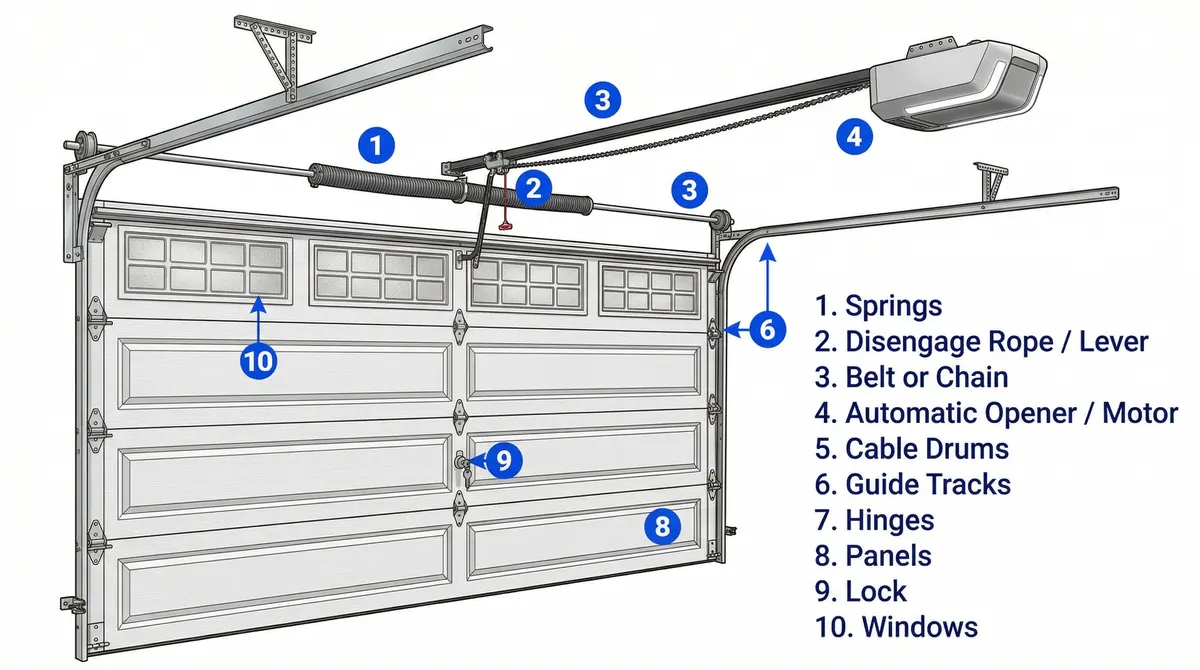
Know Your Garage Door: Every Part Explained
When a technician tells you "your torsion spring is shot" or "your extension cable jumped the drum," it helps to know what they're talking about. Understanding the parts of a garage door means you can ask better questions, catch dishonest upsells, and do basic maintenance yourself. Here's every major component from top to bottom.
Panels (Sections)
The large rectangular sections that make up the door face. Most residential garage doors have 4 or 5 panels stacked on top of each other, connected by hinges. When the door opens, these panels fold along the hinge points and travel along the curved track into the horizontal position along your garage ceiling.
- Material: Steel (most common), aluminum, wood, composite, fiberglass
- Replacement cost: $200 to $800 per panel depending on size, material, and style
- Florida note: Single-layer steel panels dent easily (hail, kids, basketballs). Insulated two-layer or three-layer panels are much more dent-resistant and hold up better in Tampa's heat.
Tracks
The metal rails on each side of the door opening that guide the rollers. You have vertical tracks along the sides and horizontal tracks that curve and run along the garage ceiling. The tracks must be level, plumb, and properly spaced, if they're bent or misaligned, the door binds, jumps, or gets stuck.
- Replacement cost: $125 to $250 per track (rarely need full replacement, usually just realignment at $75 to $150)
- Florida note: Tracks don't rust often since they're galvanized, but the mounting brackets can corrode in coastal Tampa Bay areas like Clearwater and St. Petersburg.
Rollers
Small wheels attached to the side of each panel that ride inside the tracks. Each panel has 2 to 3 rollers. Most homes have nylon rollers (quiet) or steel rollers (cheap but noisy). Your door has 10 to 12 rollers total.
- Replacement cost: $10 to $15 per roller, or $100 to $175 for a full set installed
- Lifespan: Nylon rollers last 10,000 to 15,000 cycles. Steel rollers last about 5,000.
- Florida note: Steel rollers rust and seize in Tampa's humidity. Nylon rollers are the better choice here, they don't corrode and they're much quieter.
Hinges
The metal plates connecting adjacent panels, allowing them to bend at the joint as the door opens and closes. They're numbered (1, 2, 3, etc.) based on their position. The bottom hinge is #1, and each one up is a higher number. Higher-numbered hinges have an increased offset to accommodate the track curve.
- Replacement cost: $8 to $20 per hinge, or $75 to $120 for a full set installed
- Failure sign: Squeaking, popping, or visible cracks in the hinge plate. Worn hinges also cause the door to wobble side-to-side during operation.
Springs
The most critical parts of a garage door. Springs counterbalance the weight of the door so the opener (and you) don't have to lift the full 150 to 400 pounds every time. There are two types:
Torsion Springs
Mounted on a shaft above the door opening. These twist to store energy and unwind to release it. Most modern residential doors use torsion springs. They're safer, last longer, and provide smoother operation than extension springs.
Extension Springs
Mounted along the horizontal tracks on each side. They stretch (extend) to store energy. Older homes and lighter single-car doors often have these. They're cheaper but less safe, when they break, they can fly across the garage unless they have safety cables threaded through them.
- Replacement cost: $200 to $350 for a pair of torsion springs installed; $150 to $250 for extension springs installed
- Lifespan: Standard springs: ~10,000 cycles (7 to 9 years). High-cycle springs: 25,000 to 50,000 cycles (15 to 25 years).
- Florida note: Humidity and salt air destroy springs faster. Tampa homeowners near the coast should budget for replacement every 5 to 7 years. Lubricate springs every 2 to 3 months to slow corrosion.
Cables and Drums
Steel cables connect the bottom of the door to the spring system via drums mounted on the torsion shaft. As the springs unwind, they spin the drums, which wind the cables and lift the door. Without cables, springs can't do their job.
- Replacement cost: $150 to $250 for both cables installed
- Failure sign: Fraying strands, visible rust, cable hanging loose, door sitting crooked
- Florida note: Cables corrode from the inside out in Tampa's humidity. They can look fine outside but be dangerously weak inside. Replace cables whenever you replace springs.
Bottom Bracket and Lift Cables
The bottom bracket is a heavy-duty bracket at the base of the door where the lift cable attaches. This bracket is under extreme tension because it's the connection point between the cable and the door. Never attempt to adjust or remove the bottom bracket yourself, it can cause serious injury.
Weatherstripping and Bottom Seal
Rubber or vinyl seals around the perimeter of the door (sides, top, and bottom) that keep out rain, wind, dust, and pests. The bottom seal is the most important and the most frequently replaced.
- Replacement cost: Bottom seal $75 to $125 installed; side/top weatherstripping $50 to $100 installed
- Florida note: UV and heat destroy these seals faster than in northern climates. Expect to replace the bottom seal every 3 to 5 years in Tampa. Worn seals are the #1 reason bugs get into Florida garages.
Garage Door Opener
The motorized unit mounted on the ceiling that automates opening and closing. Three main drive types:
- Chain drive: Cheapest ($200 to $300), noisiest. Fine if your garage isn't under a bedroom.
- Belt drive: Quieter ($300 to $450), uses a rubber belt instead of a chain. The most popular choice in Tampa homes.
- Wall-mount (jackshaft): Mounts on the wall beside the door instead of the ceiling ($400 to $600). Frees up ceiling space and runs very quietly. Growing in popularity.
Safety Sensors (Photo Eyes)
Two small devices mounted 6 inches off the ground on each side of the door opening. One sends an infrared beam, the other receives it. If anything breaks the beam while the door is closing, it reverses. Required by federal law since 1993.
- Replacement cost: $30 to $60 for the pair, plus $75 to $100 installation
- Common problem: Misalignment from bumps, dirt on the lens, or Florida afternoon sun overpowering the beam
Wall Button and Remote Controls
The wired wall button (usually by the interior garage door) and wireless remotes that control the opener. Modern wall consoles include features like motion-activated lighting, lock-out buttons, and timer-to-close controls.
- Replacement cost: Wall button $20 to $50; remotes $30 to $50 each
Need a Part Replaced?
Now that you know the parts of a garage door, you can talk to a technician with confidence. If something on your door isn't working right, Champions Garage Door Service can diagnose and fix it, usually in a single visit. We stock the most common parts on our trucks, so most repairs are done same-day. Call (813) 999-5749 to schedule service anywhere in the Tampa Bay area.