
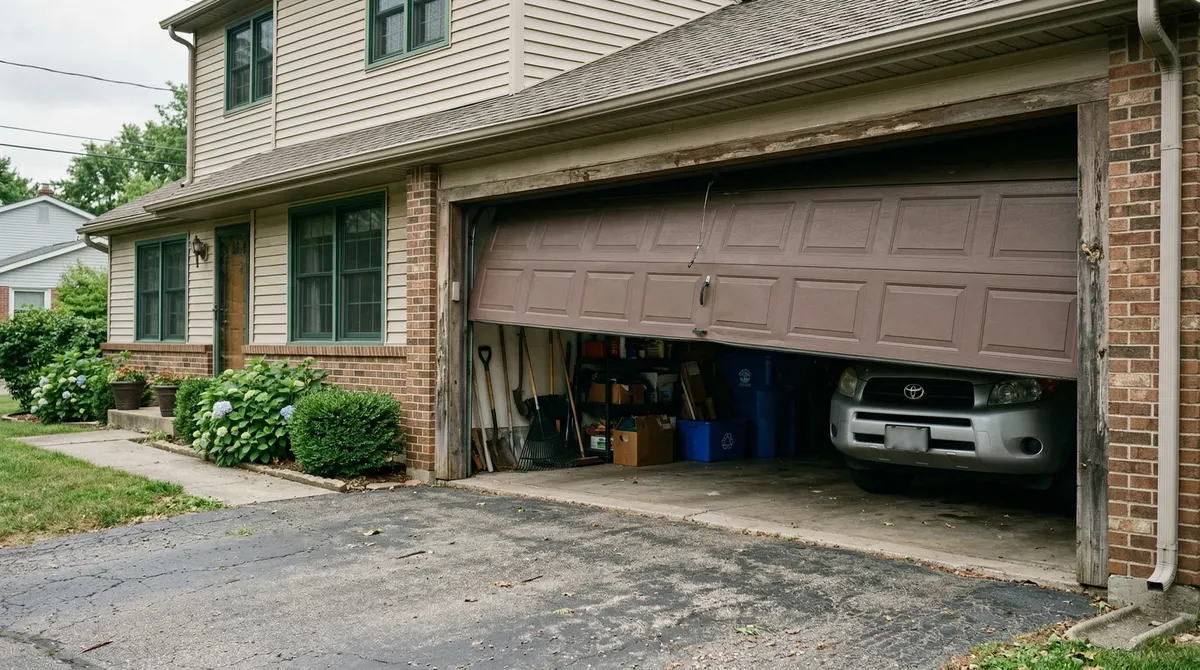
It Opens Fine But Won't Come Back Down
This is one of the most common calls we get: "My garage door opens no problem, but when I try to close it, it starts to come down and then reverses. Or it won't even start closing." You're standing in the garage pressing the button over and over, and the door just blinks at you.
The good news is that a door that won't close is usually caused by one of five or six things, and most of them are straightforward to diagnose. Some you can fix yourself in 5 minutes. Others need a technician. Here's how to figure out which one you're dealing with.
Problem #1: photo-eye sensors Are Blocked or Misaligned
This is the cause about 70% of the time. Those two small sensors at the bottom of your garage door tracks, one on each side, about 6 inches off the ground, send an invisible beam across the opening. If anything breaks that beam, the door refuses to close. It's a safety feature designed to prevent the door from closing on a person, pet, or object.
But the sensors don't know the difference between a child and a cobweb. In Tampa garages, spider webs, dust, gecko droppings, and dirt on the sensor lens are the most common culprits.
How to Fix It
- Look at the sensor lights. Typically one is green (sending) and one is amber (receiving). Both should be solid, not flickering.
- Wipe the lens on both sensors with a clean, dry cloth. You'd be surprised how much gunk builds up.
- Check if anything is blocking the beam path, a broom, a bike tire, a box, a cobweb stretching between the sensors.
- If a light is flickering, the sensor is probably bumped out of alignment. Loosen the wing nut on the bracket, adjust the sensor until the light goes solid, and retighten.
- Check the wires running from each sensor back to the opener. Look for loose connections, damaged insulation, or wires that have been chewed (rodents love garage wiring in Florida).
If both sensor lights are solid and the path is clear but the door still won't close, try the wall button. Some openers let you close the door from the wall button even when sensors have issues, you just have to hold the button down continuously until the door is fully closed. This is a temporary workaround while you figure out the real problem.
Problem #2: Close Limit Switch Needs Adjusting
The limit switch tells the opener how far the door should travel before stopping. If the close limit is set wrong, the opener thinks the door has hit the floor (or something blocking it) before it actually has. The opener interprets this as "I hit something, better reverse."
You'll know this is the problem if the door starts closing, gets most of the way down, and then reverses, but there's nothing blocking the sensors and nothing physically in the way.
On most openers, the close limit is adjusted with a screw on the back or side of the motor unit. Turn it in small increments (a quarter turn at a time), test, and repeat. Your opener manual has the specific instructions for your model. If you don't have the manual, search the model number online, every major brand has manuals available as free PDFs.
Problem #3: Broken Spring
Here's one that catches people off guard. A broken spring doesn't always mean the door won't open. In some cases, especially on double-car doors with two springs, the door can still open with one spring intact, but the opener can't generate enough force to pull the door down against the remaining spring's imbalanced tension.
Look at the springs above the door. If you see a clear gap in one of the coils, the spring is literally in two pieces with a space between them, that's your answer. The door is too heavy and unbalanced for the opener to close safely, so it gives up.
This is a technician job. Don't try to force the door closed. Call for spring replacement. In Tampa, this runs $200 to $350 for a pair.
Problem #4: Something Is Physically Blocking the Door
It sounds obvious, but check the tracks and the door's path carefully. A small rock in the track, a screw that fell into the rail, or a piece of debris can prevent the door from closing. The opener senses the resistance and reverses as a safety measure.
Run your eye along both tracks from bottom to top. Check the floor where the door meets the ground, is there anything there? Sometimes it's a child's toy, a balled-up rag, or a piece of weather stripping that came loose and got caught.
Problem #5: Remote Works But Only From Close Range
If the wall button closes the door just fine but the remote only works when you're standing right next to the opener, you have a range problem, not a closing problem. The most common cause is a damaged or disconnected antenna on the opener unit.
Look at the motor housing for a short wire hanging down, that's the antenna. Make sure it's hanging freely and not coiled up, pinched, or broken off. If the antenna is fine, the remote batteries might be getting weak, replace them even if the remote still works at close range.
Problem #6: LED Light Interference
This one is weird but real. Certain LED light bulbs installed in or near the garage can emit radio frequency interference that disrupts the signal between your remote and the opener. If your door stopped closing reliably right after you installed new LED bulbs in the garage or the opener itself, that's probably your culprit.
The fix: switch to LED bulbs specifically designed for garage door openers. Brands like Genie and Chamberlain sell them. Regular LED bulbs from the hardware store can cause intermittent signal problems that drive you crazy trying to diagnose.
Problem #7: The Wall Button Works But the Remote Doesn't
If the wall button operates the door normally but none of your remotes work, check if the lock feature is engaged. Many wall-mounted panels have a lock button (sometimes marked with a padlock icon) that disables all remotes for security. If someone accidentally bumped it, your remotes are locked out.
If the lock isn't the issue, you may need to reprogram the remote. Power surges, common during Tampa's afternoon thunderstorms, can wipe the opener's memory. Your opener manual explains reprogramming, or search YouTube for your specific model. It usually takes about 60 seconds.
When to Call a Pro
If you've checked the sensors, cleaned them, confirmed the limit settings, and the door still won't close, or if you found a broken spring, damaged tracks, or cable issues, it's time for a service call. Champions Garage Door Service handles these calls every day across Tampa Bay. Call (813) 999-5749 and we'll get it sorted out, usually the same day.