
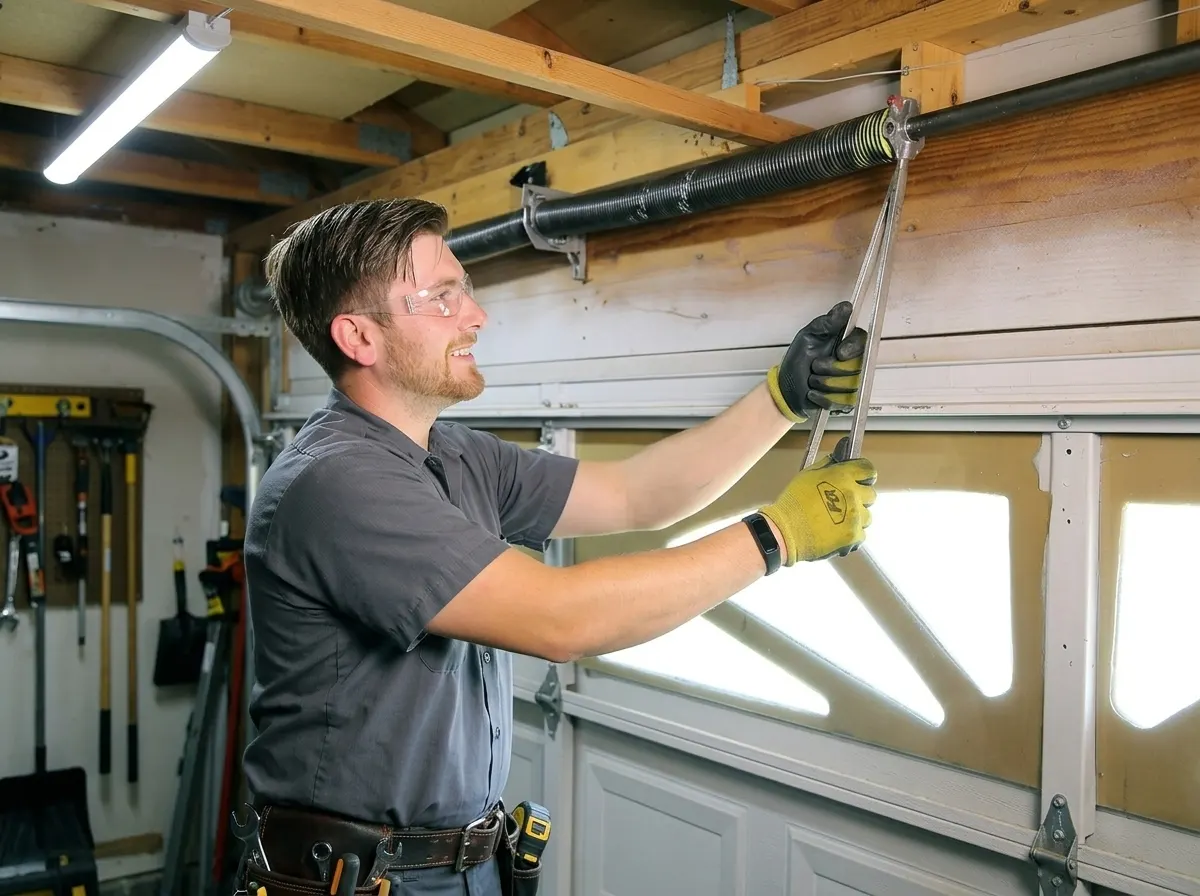
Your Spring Broke, Here's What Happens Next
You heard a loud bang in the garage. Or maybe you just pressed the button and the door barely moved, straining like it weighs a thousand pounds. Either way, you've got a broken garage door spring, and your door is basically out of commission until it's fixed.
Spring replacement is the most common garage door repair in America, and it's something we do multiple times a day at Champions Garage Door Service. Here's a straightforward walkthrough of what's involved so you know what you're getting into.
Two Types of Springs (And Why It Matters)
Torsion Springs
Torsion springs mount on a metal shaft directly above the garage door opening. They twist to store energy and untwist to lift the door. Most modern residential doors use one or two torsion springs. They're the more common type you'll see in Tampa-area homes built in the last 20 years.
Torsion springs are generally safer, longer-lasting, and provide smoother door operation than extension springs. They also give better balance control, which means less wear on your opener.
Extension Springs
Extension springs run along the horizontal tracks on both sides of the door. They stretch to store energy and contract to lift the door. You'll find these on older doors and some lighter single-car doors. They're cheaper than torsion springs but wear out faster and can be more dangerous when they break, a snapping extension spring without a safety cable can fly across your garage.
How Long Do Springs Last?
Most springs are built to handle around 10,000 open-and-close cycles. A typical Tampa household uses the garage 3-5 times a day, which means your springs are working through roughly 1,100 to 1,800 cycles annually. That puts the average spring lifespan somewhere between 6 and 9 years, depending on usage.
In Florida, expect the lower end of that range. Our heat and humidity accelerate rust and metal fatigue. Springs in Tampa homes that never get lubricated often break at the 5 to 6 year mark. Salt air near the coast makes it worse.
High-cycle springs rated at 25,000 to 50,000 cycles cost more upfront, maybe $50 to $100 extra per spring, but they'll last 12 to 20+ years with basic maintenance. That's usually one replacement instead of two or three over the life of your door.
Warning Signs Your Springs Are Failing
Springs rarely break without warning. Watch for these signs:
- The door feels heavy when you lift it manually. Disconnect the opener and try lifting the door by hand. If it's hard to lift or won't stay open at waist height, the springs are losing tension.
- Visible gaps in the coils. A healthy torsion spring has tightly wound coils. If you can see gaps or stretched sections, the spring is near the end.
- Rust on the springs. Rust weakens the metal and increases friction. Rusty springs break sooner.
- The door opens unevenly. If one side lifts faster than the other, one spring may be weaker or already broken (on a two-spring system, the door can sometimes still open with one broken spring, just poorly).
- Loud creaking or squealing. This means the coils are grinding against each other and need lubrication at minimum, replacement soon.
Why DIY Spring Replacement Is a Bad Idea
This isn't like changing your oil or swapping out a light fixture. Garage door springs store an enormous amount of energy, we're talking hundreds of pounds of force wound into those coils. When that energy releases uncontrolled, people get seriously hurt.
Every year, emergency rooms treat injuries from DIY spring replacement attempts. Broken wrists, lacerations, even fatalities. The winding bars can slip. The spring can unwind violently. The door can drop. This is one repair where the $150 to $350 you spend on a professional is the best money you'll ever spend.
What Happens During professional spring replacement
Here's the typical process when a technician shows up to replace your springs:
- Secure the door: The technician clamps the door to the track or uses C-clamps to prevent it from moving while the springs are off.
- Release tension: Using winding bars, the old spring tension is carefully unwound. This is the most dangerous step and requires proper tools and training.
- Remove old springs: The broken spring (and ideally the matching one) comes off the shaft.
- Install new springs: New springs are slid onto the shaft, secured with set screws, and wound to the correct tension for your door's weight.
- Lubricate and test: The new springs are lubricated, then the door is tested for balance and smooth operation. The opener force settings may need adjustment.
The whole process takes about 45 minutes to an hour for a standard two-car garage door. Most technicians carry common spring sizes on their truck, so there's no waiting for parts.
Cost Breakdown
In the Tampa Bay area, expect to pay:
- Single torsion spring: $150 - $250
- Pair of torsion springs: $200 - $350
- High-cycle upgrade (per spring): Add $50 - $100
- Extension springs (pair): $150 - $250
That includes the springs, labor, and a warranty. If other components like cables or rollers need attention while we're there, your technician will let you know and quote those separately.
After Replacement
New springs should give you smooth, quiet, balanced operation right away. Keep them lubricated every 3 to 4 months with a silicone-based garage door spray, and they'll last well beyond their rated cycle count. If you notice any unusual sounds or behavior after replacement, call the company that did the work, it may just need a minor tension adjustment.
Need a spring replacement in Tampa? Call Champions Garage Door Service at (813) 999-5749. We carry springs for most residential doors and offer same-day service.